1.0 Introduction: The Sale I Was Sure I'd Win... and Promptly Lost!
I remember it clearly. It was a seven-figure enterprise software deal, and I had it in the bag. The prospect's technical team loved the demo, the economic buyer agreed we’d deliver a massive ROI, and we were perfectly aligned on the implementation timeline. All that was left was the final signature. On our last call, I went in for the close, laying on the pressure. I reminded them of the end-of-quarter discount, the implementation team's limited availability, and how their competitor was moving ahead with a similar solution. I was sure they'd sign right then .
They went silent. A few days later, I got the email: "We've decided to go in a different direction." I was stunned. The deal wasn't just lost; it felt like they had run in the opposite direction. I hadn't lost the deal on price or features. I had lost it because I pushed too hard and made them feel like they had no choice. It was a painful but critical lesson that set me on a new path: instead of forcing a sale, I needed to learn how to adapt to my customer. I had stumbled upon the core principle of what sales researchers call adaptive selling.
2.0 Why Your Prospects Resist: It’s Not Price, It’s Psychological Reactance
For years, I diagnosed that failure in all the wrong ways. Did I miss a key stakeholder? Was our price too high? As a sales coach, I see this mistake every day. But as a psychologist, I know what's happening under the surface is much deeper, rooted in a fundamental human drive. The problem was something psychologists call Psychological Reactance Theory (PRT), first proposed by Jack Brehm in 1966.
PRT is built on two simple but powerful assumptions:
1. People believe they have a set of "free behaviors" they can engage in—choices they feel entitled to make.
2. When those freedoms are threatened or eliminated, people become motivationally aroused to restore them.
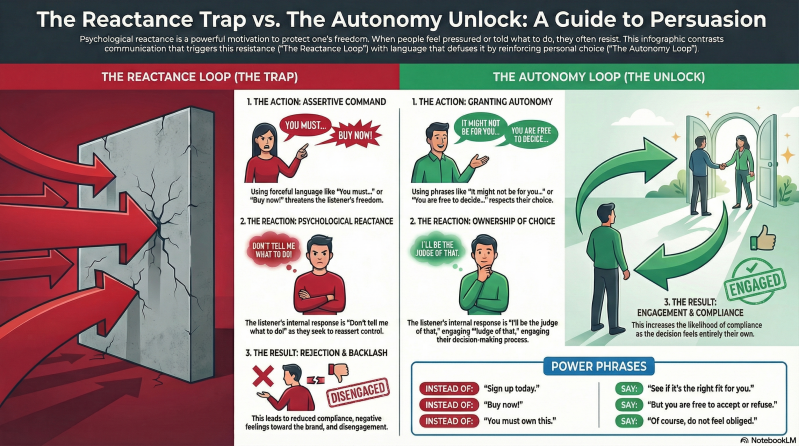
That feeling of arousal—that urgent need to re-establish control—is the "Sales Resistance" you feel from a prospect. It's not about your product or your pricing. It's a primal reaction to a perceived threat to their autonomy. When a salesperson says, "You must sign today to get this price," they aren’t just presenting a deadline; they are threatening the client's freedom to choose when and how they make a decision.
The result is often a boomerang effect: the prospect doesn't just resist, they actively adopt the opposite position to restore their sense of freedom. In sales, this means your "must-have" quarterly deal becomes their "nice-to-have" Q2 project precisely because you tried to force the timeline. The harder you push them to say "yes," the more they want to say "no."
Crucially, the intensity of this resistance is directly proportional to the severity of the threat. Research by Heilman (1976) and later by Rains & Turner (2007) found that more intense social influence attempts—what we would call pushy sales tactics—instigate greater oppositional behavior. You don't overcome resistance by applying more force; you only make it stronger.
3.0 The 'Un-Sale': The Power of Supporting Autonomy
A few years after losing that seven-figure deal, I was in a meeting with a smaller, more skeptical prospect. The old me would have gone into overdrive, hammering them with case studies and ROI calculations. But this time, remembering my past failure, I tried something different. After my presentation, I looked at the lead decision-maker and said, "I'm not sure if this is the right fit for you. Based on what you've said, you could probably get by with your current system or even go with our competitor, and that's a perfectly valid choice."
The room's dynamic shifted instantly. The prospect, who had been leaning back with his arms crossed, leaned forward. He started making the case for me, explaining why his current system wasn't working and why our solution was, in fact, the better option. They signed the next week. By giving up control, I gained influence. It was the ultimate paradox, and it’s rooted in the principle of Autonomy Support.
Autonomy support is the direct opposite of the controlling language that triggers psychological reactance. Instead of trying to restrict a prospect's choice, you actively work to restore it. The difference in communication style is stark:
A perfect, real-world application of this principle is the "But-You-Are-Free" (BYAF) technique. This simple tactic explicitly reminds someone of their freedom to choose, which dramatically increases their willingness to comply. By adding a phrase like "...but you are free to accept or refuse," or alternatives like "do not feel obliged" or "feel free to refuse," you induce a feeling of freeness. This de-escalates the perceived threat to their autonomy, directly reducing the psychological reactance that fuels sales resistance. This technique is particularly effective in individualistic cultures, where the drive for personal control is strong and reactance is more easily triggered.
4.0 Putting Autonomy Support into Practice: Three Key Shifts
Integrating this into your sales process doesn't require a massive overhaul. It's a coaching plan built on small but powerful shifts in your approach to restore control to the buyer.
1. Shift Your Language. The single most effective change you can make is to purge controlling words from your vocabulary. Replace words like "must," "should," and "ought" with autonomy-supportive alternatives like "perhaps," "consider," and "maybe." This isn't just about being polite; it's a strategic transfer of perceived control that lowers their defenses and makes them feel like a partner in the decision rather than a target of your pitch.
2. Emphasize Their Freedom to Choose. Don't just imply their freedom; state it explicitly. Use phrases from the BYAF technique like, "Of course, do not feel obliged," or "The decision is entirely yours, so please feel free to refuse." This language acts as a pressure release valve. It defuses the psychological tension that creates reactance, making it easier for the prospect to evaluate your offer on its merits instead of reacting to a perceived threat.
3. Offer Choice, Don't Eliminate It. Psychological research shows that when a person's free behaviors are threatened, the attractiveness of that threatened behavior increases (Brehm & Rozen, 1971). When you use an ultimatum like "This is the last day to get this price," you eliminate their freedom to buy tomorrow at that price, which can paradoxically make them want to wait. Instead of removing options, present them. Frame the conversation around different packages, timelines, or implementation paths to reinforce the customer's role as the ultimate decision-maker.
The Takeaway
Sales resistance is not a mysterious force. It is a predictable psychological reaction to a perceived loss of control and autonomy. For decades, we've been taught to overcome this resistance by pushing harder—by being more persuasive, more aggressive, and more relentless. But this approach only fuels the very reaction we're trying to prevent.
The "Un-Sale" is a philosophy built on backing off and actively restoring the customer's sense of freedom at every turn. It is the psychological engine for mastering adaptive selling, a competency managers consistently identify as a critical success factor for sales professionals. Researchers Weitz, Sujan, and Sujan (1986) famously defined this skill as “the altering of sales behaviors during a customer interaction...based on perceived information about the nature of the selling situation.” By understanding the principles of reactance and autonomy support, you gain the insight needed to make those alterations effectively.
Stop selling, and start empowering. By shifting your language, explicitly affirming their right to choose, and presenting options instead of ultimatums, you transform a high-pressure confrontation into a collaborative partnership. This is the key to defusing resistance, building genuine trust, and ultimately, closing more deals in a modern sales environment.
Add comment
Comments